
P26 · I.01(b) · N.01(b) · Project indexes · Economy · CAPEX stage-gate
Final Investment Decision — FID
Stage-gate playbook, FID package contents, LSE appraisal (NPV / IRR / payback / ARR), debiasing protocols and governance checklists.
François Dorléans · LSE MBA Essentials (Feb–Apr 2023, cert. 342406) · 11 September 2026 · partner comments locked
Partner review (protected): each section has a #tag. Comments blocked for the public until ?role=partner.
LSE golden rule before opening the file
A long-term investment decision must maximise shareholder wealth. Judge cash flows, not accounting profit. NPV is the most accurate method because it incorporates the time value of money. Study costs already spent are a sunk cost: they never justify a bad FID.
Contents
- 1. Purpose, audience and how to use this brief
- 2. What FID is — and why it changes everything
- 3. LSE MBA Essentials — what belongs inside a FID
- 4. Stage-gate architecture to FID
- 5. Gate 0 — Identify / Appraise / FEL-1
- 6. Gate 1 — Select / Pre-feasibility / FEL-2
- 7. Gate 2 — Define / FEED / FEL-3
- 8. Gate 3 — The FID
- 9. Standard FID package (committee file)
- 10. Investment appraisal — how the numbers must be built
- 11. Risk, sensitivities and scenarios
- 12. Cognitive biases and debiasing (LSE Module 8)
- 13. Governance, roles and RACI
- 14. Master pre-FID checklists
- 15. After FID — what the brief must already specify
- 16. CV, interview and sponsor one-pager language
- 17. Annexes — glossary, formulae, sources
2. What FID is — and why it changes everything
2.1 Before / at / after FID
| Before FID | At FID | After FID | |
|---|---|---|---|
| Nature of spend | Studies, options, FEED | Capex commitment + launch opex | Execute, commission, operate |
| Typical cost uncertainty | ±50%, then ±30%, then ±10–15% | Commitment-class estimate | Control vs baseline |
| Governance question | Should we keep studying? | Do we commit the capital? | Are we delivering the promised value? |
| Possible outcome | Go / Recycle / Kill | Approve / Defer / Reject | Change control, lookback |
| Dominant bias | Overconfidence, champion bias | Sunk-cost, confirmation | Planning fallacy realised |
Table 1 — FID as a change of spending regime and governance regime.
2.2 The three committee outcomes
LSE discipline — sunk-cost fallacy (Module 8)
3. LSE MBA Essentials — what belongs inside a FID
3.1 Modules used
3.2 The four appraisal methods (LSE Module 6 Unit 4)
3.3 What LSE adds beyond the formulae
4. Stage-gate architecture to FID
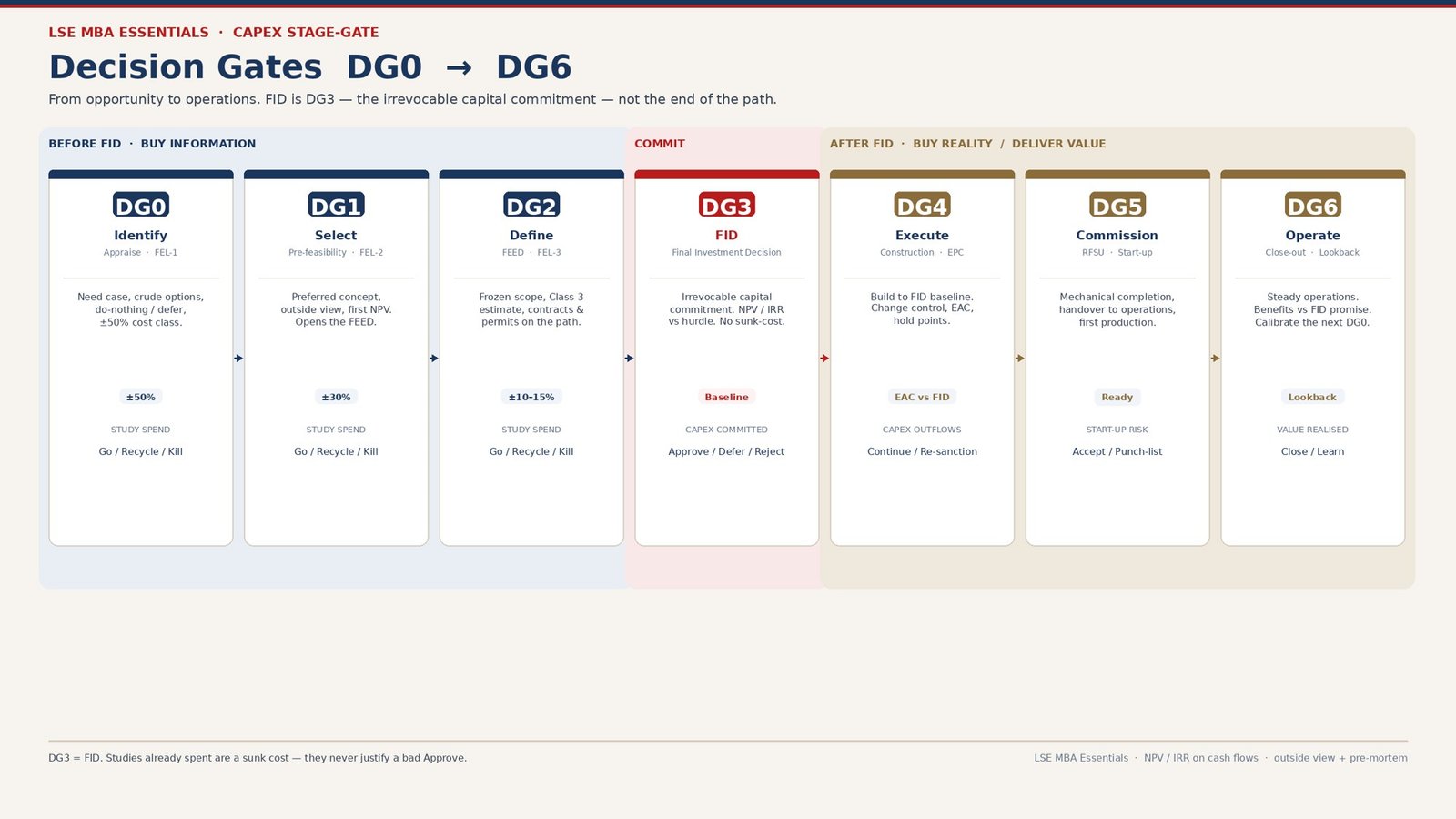
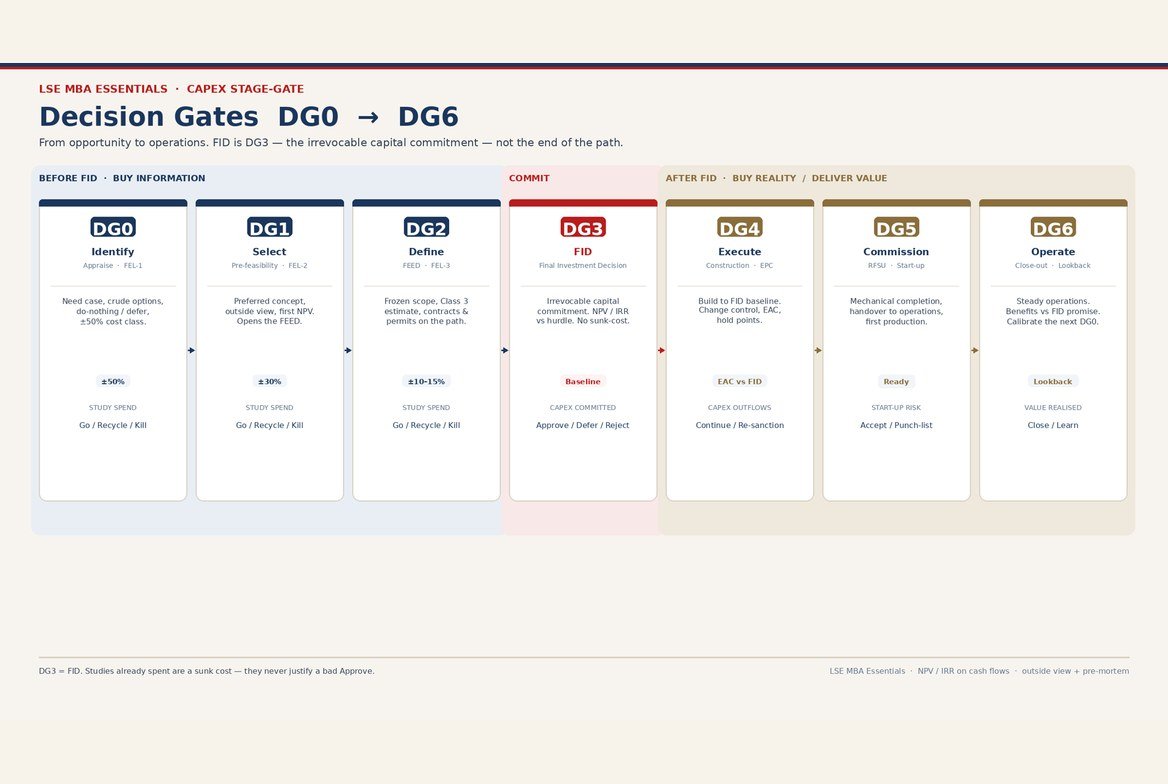
4.1 Language mapping
| This brief | Oil & gas / IPA | Infra / utilities | PMI (approx.) | Typical cost uncertainty |
|---|---|---|---|---|
| G0 Identify | FEL-1 Appraise | Opportunity / need case | Initiating | ±50% (Class 5) |
| G1 Select | FEL-2 Select | Pre-feasibility / options | Planning early | ±30% (Class 4) |
| G2 Define | FEL-3 Define / FEED | Feasibility / detailed design | Planning late | ±10–15% (Class 3) |
| G3 FID | FID | Financial close / sanction | End of Planning | Commitment baseline |
| Execute | Execute | Construction | Executing | EAC control |
Table 3 — FEL / infrastructure / PMI translation. Adapt the labels to your committee jargon, not the logic.
4.2 Economics of information
5. Gate 0 — Identify / Appraise / FEL-1
5.1 Work to complete
5.2 Gate deliverable and decision
6. Gate 1 — Select / Pre-feasibility / FEL-2
6.1 Work to complete
6.2 Outside-view protocol — five LSE steps
6.3 Gate deliverable and decision
7. Gate 2 — Define / FEED / Feasibility / FEL-3
7.1 Engineering and scope
7.2 Estimating and schedule
7.3 Contracts, permits, HSE, ESG, financing
7.4 Mandatory pre-mortem before the file is sent
8. Gate 3 — The FID
8.1 Questions the committee must ask
8.2 Typical conditions precedent
9. Standard FID package (committee file)
9.1 Binder architecture
9.2 The decision note (three pages maximum)
9.3 What Finance must certify in tab 04
10. Investment appraisal — how the numbers must be built
10.1 Criterion hierarchy
10.2 Working formulae
10.3 LSE teaching mini-case
10.4 What a live FID adds to the course example
10.5 Ratio link (Module 7)
11. Risk, sensitivities and scenarios
11.1 Minimum set
11.2 Translating risk into governance
12. Cognitive biases and debiasing (LSE Module 8)
12.1 Biases that specifically hit the path to FID
12.2 Debiasing toolkit to write into the process
13. Governance, roles and RACI
13.1 Roles
13.2 Session rules
14. Master pre-FID checklists
14.1 Technical maturity and estimate
14.2 Economics and finance
14.3 Risk, legal, execution
15. After FID — what the brief must already specify
16. CV, interview and sponsor one-pager language
16.1 CV line
16.2 Interview answers
16.3 Sponsor one-liner in session
17. Annexes — glossary, formulae, sources
A. Working glossary
B. Formula reminders
C. Teaching sources used
D. Project instantiation
Close — what to remember