1. Thesis in one page
The commercial shutdown of Celsius Energy is not a drilling failure. It is the diagnosis of a market too thin, too slow and too exposed to aid instability, even though the technique — star drilling transferred from oil — had already lifted the urban land lock. Geothermal economics are simple: drilling concentrates capex; operations concentrate the rent. As long as Europe stays artisanal (few wells per year, precarious crews, administrative reviews of several months), cost per metre does not fall, training is not amortised and personnel is not made reliable.
A cadence of 300 to 500 wells a year, comparable to what the Omani national operator drills each year, assumes an administrative instruction throughput that France does not reach today: few filed dossiers are finally approved, and those that are cross DREAL / ADEME / prefecture reviews that stretch over several months, sometimes more than a year. Displaying an industrial cadence target without first acting on that throughput sets an unreachable short-term horizon and, by backlash, discredits a sector that already knows how to drill cleanly in cities.
The project is therefore no longer massification alone: it is adaptation. Adapt here means deliberately matching the targeted drilling cadence to the real throughput of dossier approvals, while acting on that throughput, rather than promising a cadence the administrative apparatus cannot absorb. European massification (§8) remains the medium-term horizon; adapting French instruction throughput (§5 and §6) is the short-term precondition. +EECM (§7) makes the economic equation readable city by city: the current energy spend of the building stock is the price paid, every year, for the absence of sovereignty. Investment in a more efficient, sovereign system pays back in 10 to 20 years on average — compatible with a municipal mandate, a long tertiary lease and probe life (40 to 80 years) — provided instruction delay does not itself load the calculation (§9.3).
| Finding | Lock | Way out |
|---|
| Market too slow. Celsius Energy stops commercial activity despite proven oilfield technology. | Targeted technical cadence (300–500 wells/year, Oman reference) far above France’s real dossier-instruction throughput. | Adapt instruction throughput (SOP conditioning aids, accelerated reviews) then massify Europe. Phased cadence, amortised training, +EECM city by city, ROI 10–20 years. |
| Drilling capex + unstable aids + DREAL/ADEME/prefecture delays (often ~18 months in deep) + lengthened owner decisions + no field-based verification method. |
Table — finding, lock, way out. Massification is the medium-term horizon; Adaptation is the French short-term gate.
2. Celsius Energy lesson — facts to keep
Reference source: Valentin Hamon-Beugin, L’Usine Nouvelle, Paris, 10 September 2026. Financials and deliveries from the public file and 2024 accounts.
2.1 Decision and market diagnosis
French surface-geothermal subsidiary, born in 2019 as an internal SLB (Schlumberger) spin-off. Commercial activity stopped, confirmed early September 2026; commitment to finish already contracted sites. President Cindy Demichel: “The geothermal market is not taking off enough.” Diagnosis of insufficient market, not technical failure. The same filter appeared as early as May 2026 in GreenUnivers: too few projects versus the marching plan; delays too long to get them out of the ground. About 100 staff to be reassigned progressively inside SLB or made redundant.
2024 accounts: turnover €12.36 m (versus €7.03 m in 2023), net loss €6.90 m, share capital €33.01 m. Continuation voted on 20 June 2025 despite equity below half of capital. Seat transferred to Clamart (1, rue Henri Becquerel) on 22 October 2025.
2.2 Stated causes — not the technique
Recent sector support measures did not offset the instability of public aids. Prospective clients step back from the initial investment cost, carried essentially by drilling, even when operations become profitable in the long run. In France, political wait-and-see has, according to C. Demichel, doubled owners’ decision time; 2025 is called a “very complicated” year. The ADEME Heat Fund, briefly threatened, was kept, but its terms of use may harden; the local-authority Green Fund nearly disappeared, which froze arbitrage. In the United States a “paradigm change” in private-company sustainability policies happened “directly and brutally”; the administration mainly favours very-high-temperature deep geothermal (power, datacentres), not surface geothermal. The 2026 summer heatwaves highlight the need for durable cooling, but “renewed interest does not always show up as a decision”.
2.3 What the technique had already solved
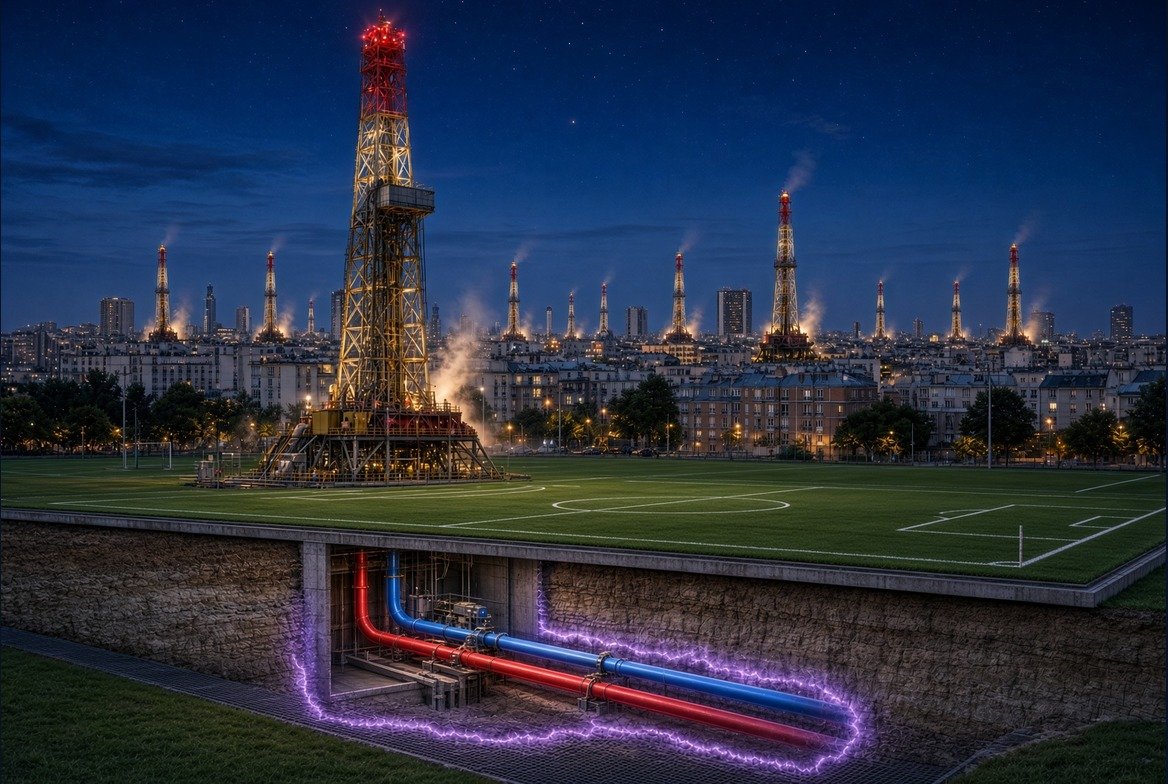
Distinctive innovation: star drilling transferred from the oil industry. From a single point, several inclined wells fan out to about 200 m, in rock at 12–15 °C, with double-U probes and a closed-loop heat-transfer fluid. Surface footprint divided by 10 versus a classic vertical probe field, sometimes down to about 20 m² — intervention possible at the foot of an existing building.
Cited deliveries: new Framatome workshop at Le Creusot (EPR2 vessel internals); Ferney-Voltaire / Pays de Gex loop (173 wells to 230 m, 40 km of drilling, €30 m, CERN waste-heat recovery); Le Vulcain social housing in Nîmes (133 dwellings); Banque Populaire Auvergne Rhône-Alpes headquarters at Corenc (7,680 m²). Operations also in the United Kingdom and the United States. Operational conclusion: the technology reduced a real urban land lock. It did not overcome the couple high entry cost + unstable aid schemes, which stretches decision cycles beyond the capacity of a subsidiary still industrialising.
3. General economics of geothermal
3.1 Three storeys, one physics
| Storey | Depth / T | Use | Cost order | Asset life |
|---|
| Surface (GMI / probes / aquifer) | 15–200 m · 12–20 °C | Heating + cooling, water/water HP | €50–160/m drilled; €15–55 k house; €m collectives | Probes 40–80 y · HP 20–25 y |
| Deep heat (calogenous) | 800–2,000 m · 40–90 °C (Dogger, etc.) | Urban district heat | Doublet: €2–5 m+ per well pair | Wells 30–40 y+ · plant 25–40 y |
| Deep power / EGS / HTH | > 2,000 m · > 120–350 °C | Electricity, process, datacentres | Heavy industrial capex | Long asset, LCOE already ~$60/MWh in the best cases |
Table 1 — three storeys. Unit and metre-cost conventions: Formulaire du foreur, IFP, ISBN 2-7108-0560-X. Typical Western Europe gradient ≈ 3 °C / 100 m. Geothermal HP COP 4 to 5 (SPF 3.5–5) versus 2.5–3.5 air-source.
3.2 Cost structure — drilling is the bottleneck
On a surface plant, drilling + probes often represent 35 to 55 % of capex. On a deep doublet they represent almost all geological risk and a majority of capex. That is why Cindy Demichel is right to point at entry cost, and why any policy that treats drilling as a “construction accessory” misses the target.
| Item (surface, collective/tertiary) | Typical capex share | Cost-down lever |
|---|
| Drilling + cementing + double-U probes | 35–55 % | Cadence, Ø standardisation, multi-well, star, automation |
| Water/water HP + hydraulics + controls | 25–40 % | European industrial series, CEE BAR-TH-178 / BAT-TH-162 |
| Studies, TRT, owner’s engineer, insurance | 8–15 % | Type dossiers, SOP, inter-municipality pooling |
| Civil works, plant room, connections | 10–20 % | Reduced footprint (star), occupied-site intervention |
Table 2 — surface cost structure. Cadence is the lever that moves the 35–55 % drilling block.
3.3 Operating account — where ROI is won
Operations invert the ratio. Once the hole is drilled, the thermal kWh comes out at a low, local, non-imported marginal cost, unexposed to TTF gas. COP 4–5 divides electricity use by four to five versus Joule heating, and by about two versus an air/water HP in a harsh winter. Probes outlive two HP generations.
| Quantity | Fossil / imported (ref.) | Sovereign geothermal | Effect |
|---|
| Annual energy cost (typical collective) | Volatile gas / oil | Electricity × 1/COP + low O&M | −30 to −70 % depending on tariff and SPF |
| Exchanger life | 15–20 y boiler | 40–80 y probes / wells | Drilling capex amortised twice |
| Sovereignty | Gas import, TTF price | Resource under the building | Bill internal to the territory |
| Summer cooling | Air/air AC (urban dump) | Geo-cooling / reversible HP | 2026 heatwaves = economic argument |
| Payback horizon | Perpetual opex | 10–20 years on average | Compatible with mandate / lease / green debt |
Table 3 — operating account. Documented orders of magnitude: house, drilling €50–160/m, median install ~€22.5 k before aids; collectives and tertiary: €1,000–1,500/kW vertical probes. Deep networks: payback often 7–13 years when the reservoir delivers. AFPG cooling study: NPV positive ~€875 m over 50 years for a Paris scenario. Netherlands: ATES ~€118/MWh vs gas €162/MWh in a high-price window — French surface long showed ~€143/MWh without subsidy, hence the Heat Fund.
3.4 Public targets vs cadence reality
PPE3: 10 TWh surface heat and 6 TWh deep heat in 2030 (versus 4.8 and 2.2 TWh in 2025). National action plan: 6,000 individual HPs and 1,000 collective-tertiary operations a year at surface; +40 % deep operations to reach at least 110 in service via projects launched before 2030. 2023 production: ~4.7 TWh surface + 2.3 TWh deep, about 1 % of French final heat. The PPE gap is not a resource problem. It is a problem of well cadence, dossiers and crews. Field experience assembled in §6 shows the dossier — not the well or the crew — as the factor that now dominates: a review run with real site competence is settled in hours, when the matching administrative instruction stretches into months.
4. Geo-energy recap
Technical “cats” useful to a geo-energy decision-maker: units, cadences, metre costs, cementing, footprint.
4.1 Base data — surface
| Parameter | Symbol / unit | Order of magnitude |
|---|
| Mean geothermal gradient | Γ (°C/100 m) | ≈ 3.0 (Paris Basin 3–3.5) |
| T at 150–200 m | T_f (°C) | 12–15 (closed loop) |
| Unit probe length | L (m) | 80–230 depending on load and rock λ |
| Indicative extractable power | q (W/m) | 35–55 W/m (TRT mandatory beyond a threshold) |
| Probe | — | Double-U HDPE, glycol water, closed circuit |
| Classic vertical-field footprint | S (m²) | Decametres to hectares depending on n |
| Star-drilling footprint | S* (m²) | ÷10 · sometimes ≈ 20 m² at the building foot |
| Linear cost drilling + probe | c (€/m) | 50–160 · median ≈ 105 (2025) |
| Potable-aquifer protection (Albian…) | — | Two-stage cementing; real extra cost |
4.2 Base data — deep heat (Dogger / Bathonian type)
| Parameter | Symbol / unit | Order of magnitude |
|---|
| Paris Basin target | z (m) | 1,500–2,000 (Dogger / Bathonian) |
| Fluid temperature | T (°C) | 55–85 depending on sector |
| Architecture | — | Producer / injector doublet |
| Geological risk | — | Productivity, reinjectability, corrosion, scaling |
| Unit drilling capex | € | Several €m; €2–5 m+ the doublet depending on context |
| Mud logging / well geology | — | Indispensable; not an ISO luxury |
| Administrative cycle duration | months | Often > a SME’s industrial cycle |
4.3 Cadence — the variable that sets the price
Oil-drilling references that the French geothermal sector has not yet imported as a production norm: Oman PDO, 300 to 500 wells/year; Australia, automated rigs on 24-month firm orders. In French geothermal we stay in isolated-site regime, nomadic crews, 100+ hours a month, precarious housing, un-revalued base trades (floorman, tonghand, roustabout, mud technician, mud logger, field geologist, driller). Mechanical result: cost per metre embeds idle time, turnover and the absence of a cumulative learning curve. European massification — multi-year order books, unique SOPs, dossier reviews in hours not months — is the only way to bring c (€/m) down while raising quality. It is also the only way to amortise a drilling school: a class is only profitable if the metres drilled afterwards actually exist.
These oil cadence references remain a useful horizon to calibrate a medium-term target; they are not, given current French instruction throughput, a short-term target. The Adaptation project (§5) states how to phase the ramp-up without repeating the gap between discourse and reality already paid by Celsius Energy — and without waiting for a scandal to impose the correction (§6.5).
5. Adaptation project — from theoretical cadence to instructable cadence
5.1 Why adaptation precedes massification
Comparing France directly with Oman or Australia has a limit that must be named: PDO is a single, integrated national operator that controls land, subsurface and the instruction of its own drilling programmes. The French geothermal sector adds a multitude of owners, engineering offices and drilling contractors, each having to obtain separately the approval of several authorities (DREAL or DRIEAT by region, ADEME, prefecture), with no one-stop shop and no bounded delay. The number of dossiers filed remains low, and the share actually approved within a delay compatible with an industrial calendar is lower still. Setting 300 to 500 wells a year as a sector target, without first settling that throughput, amounts to announcing a cadence the administration itself cannot absorb — and to repeating, at country scale, the gap between displayed ambition and execution reality that Celsius Energy already paid in cash at company scale (§2).
5.2 Instruction throughput as a steering variable
The Formulaire du foreur treats cost per metre (c, €/m) as the variable that sets the price (§4.3). Adaptation proposes to treat, beside it, instruction throughput — the number of dossiers actually approved per month and per instructing authority — as a steering variable in its own right, tracked and published on the same footing. This variable is today documented by no public dashboard known to the author; it is deduced, at best, from average delays reported case by case by project promoters. Making it visible is the first step of an adaptation policy: one does not steer what one does not measure, and a published instruction throughput becomes, for the administration itself, a performance target on the same footing as installed TWh.
5.3 A simple, non-punitive operating protocol, conditioning aids
Field experience assembled in §6 converges on a single recommendation, already put to the competent authorities (§6.5): rather than an extra ISO-compliance layer, every company in the contractual chain — from the owner’s engineer down to the last site operator — should display and follow a simple continuous-improvement plan, built on the drilling operating standard already used by the oil industry (API referential, about forty criteria), rather than on a heavier ISO transposition. The matching audit would start from the owner’s-engineer plan and walk down the subcontracting chain, led by an authority truly independent of the sector. The proposed conditionality is not a sanction: it reserves ADEME aids and other public support for operators who accept to display that plan and follow it. Without that lever, the recommendation stays optional against already installed practices.
5.4 A proof of concept on review speed
A full review of a deep-geothermal dossier archive, led by a person with real operational site experience, was carried out in four hours in the field-experience file transmitted to the competent authorities (§6.5), against a current instruction delay of the order of eighteen months for this type of dossier. That review showed obsolete certifications reproduced from dossier to dossier by simple copy-and-paste, without substance check. The gap between those two durations — four hours versus eighteen months — is not a gap of technical complexity; it is a gap of method. An examiner who combines administrative competence and time on the site detects in hours what a purely documentary review does not detect in months. It is this method, generalised, that the Adaptation project proposes to carry the cadence ramp-up — before, not after, announcing Oman-type targets.
6. State of the art — economic relevance of deep drilling and field experience
6.1 What the economic state of the art already held
On a deep doublet, drilling concentrates almost all geological risk and a majority of capex (§3.2). Sector literature (AFPG, Cour des comptes January 2026, EGEC, Ember Energy) documents a 7 to 13 year payback when the reservoir answers, and an already competitive LCOE for EGS in the best cases (~$60/MWh). This note adds a line that usual payback models omit: the cost of the instruction delay itself.
6.2 The economic cost of instruction delay
A drilling capex immobilised for eighteen months of instruction carries a carrying cost — interest during construction, inflation of material and labour items, extra risk premium demanded by the lender — that appears in none of the payback bounds of §9.2. That cost mechanically pushes the displayed profitability threshold, and it adds a second, less visible effect: a dossier suspended eighteen months also immobilises the team that prepared it, which interrupts the learning curve (§4.3) and raises the next metre. Instruction delay is therefore not neutral for deep-drilling economics: it is an extra sensitivity variable, on the same footing as the gas price, the electricity price or the real COP (§9.1).
6.3 A bypass mechanism that weighs on crew reliability
Field experience transmitted to the competent authorities (§6.5) documents a structural mechanism rather than an isolated case: when a fixed-term contract stops for lack of a following dossier, self-employed consultants — sometimes in a precarious situation, not subject to the same mandatory medical visits — can stay on the site, partly funded by public-aid schemes, when CDD employees are the first stopped. This mechanism does not proceed from a deliberate will to harm on the part of any one employer; it reveals a structural fault in how contractual status, rather than competence or real compliance, determines who stays on the site. Economically it produces the inverse of the crew reliability described in §8.3: more turnover, more variance, hence a project WACC higher than the one a theoretical dossier displays.
6.4 ADEME allocations: a scheme that barely reaches site conditions
As currently structured, ADEME support funds operators and projects; it rarely reaches the concrete working conditions of those who drill at squeezed prices. Prefectural heat-wave precaution recommendations, though published, do not systematically translate on sites. There is thus a double layer of scheme — one administrative and financial, the other operational and human — that do not meet. The conditionality proposed in §5.3 aims precisely to make those two layers converge, without loading the scheme with an extra compliance layer.
6.5 Scope and origin of this field experience
The findings of §5.4 and §6.2 to §6.4 synthesise field experience conducted by the author on French geothermal sites between 2024 and 2026, first as a GMI-certified floorman on 15 to 200 m wells, then as a mud logger on deep wells targeting Dogger and Bathonian formations. This experience was brought, in the first half of 2026, to the knowledge of the Prime Minister’s services, who directed it to the ministry competent for Energy for examination; a follow-up correspondence was sent to that ministry in early September 2026. For confidentiality and at the author’s request, that correspondence is not cited here by name or internal references: only the anonymised substance findings are reused in this note.
7. The +EECM project — city-by-city demonstrator
7.1 Object
+EECM (Évaluation Énergétique des Consommations Municipales / Massification) is a demonstration tool, municipality by municipality and inter-municipality by inter-municipality. It does not replace BatEnR (Cerema / ADEME / DGEC) or EnRezo. It translates the real bill of the building stock — residential, tertiary, public, social — into an annual price paid for the absence of energy sovereignty. Principle: energy spent in the immobile (heating, DHW, cooling) is already an outbound monetary flow. That flow is the best approximation of the “energy rent” the city pays to supply chains it does not control. +EECM sets that rent against the service rendered by a more efficient sovereign system (surface geothermal, aquifer, deep, eco-district loops, waste-heat recovery). The Adaptation project (§5) is the upstream complement: without improved instruction throughput, the cash-flow path +EECM promises city by city remains subject to the same administrative hazard documented in §6.
7.2 What the tool calculates, city by city
| Block | Input | Output useful to the mayor / DGS |
|---|
| Building stock | m², EPC, uses, current mix (gas, oil, Joule elec, DH) | Annual bill € and MWh of the territory |
| Price without sovereignty | Gas / elec / oil tariffs + 5–10 year volatility | “Energy rent” €/year and €/capita |
| Geo resource | Probes, aquifer, deep, waste heat (CERN, process, data) | MWh potential and associated drilling capex |
| Sovereign scenario | Geo HP, DH, closed loop, urban star | Target opex, t CO₂ avoided, local jobs |
| ROI bank | Aids (Heat Fund, CEE ×5, Green Fund), debt, energy inflation | Payback 10–20 years · NPV 25 and 40 years |
7.3 Economic message to get across
An owner who “waits for a more stable aid” continues to pay, every winter and every heatwave, the full price of non-sovereignty. Wait-and-see is not neutral: it capitalises a bill. +EECM makes that waiting cost visible. That is precisely the mechanism described by Cindy Demichel — renewed interest without a decision — that the tool must break, dossier by dossier, municipal council by municipal council. Profitability target: 10 to 20 years on average to move from an imported, inefficient system to a more efficient sovereign system. That interval matches observed payback on well-sized collective operations and networks (often 7–13 years in deep when the reservoir answers, 12–20 years at surface outside maximum aids), one to two municipal terms, the first life of the HP while the underground exchanger continues, and a green-debt and energy-performance-contract horizon.
7.4 Articulation with existing public tools
BatEnR characterises, building by building, thermal RES potential (network, aquifer, probes, solar thermal, wood, air HP). +EECM feeds on it and adds the layer the decision-maker actually asks for: the price paid today without sovereignty, and the cash-flow path to ROI. CEE sheets BAR-TH-178 (collective residential) and BAT-TH-162 (tertiary), bonused ×5 until 2030, must be integrated by default in the financial engine, as must the Heat Fund and, for local authorities, the Green Fund when it is open.
8. Massification in Europe — make training pay, make crews reliable
8.1 Why the scale must be European
A national market that is too narrow kills nascent industrialisations — Celsius Energy is the accounting proof (rising turnover, persistent losses, commercial stop). Europe has the subsurface, the sedimentary basins, oil-drilling know-how and an EGEC target: up to 25 % of heat and cooling demand. Ember Energy (2026) estimates ~43 GW of EGS potential under €100/MWh in the EU (Hungary, Poland, Germany, France in the lead). Staying in 27 permit regimes and 27 aid regimes is choosing never to bring cost per metre down. Massification is not “more subsidies”. It is a multi-year order book thick enough to run rigs and crews 200 days or more a year instead of moving them site to site, to standardise Ø, cementing programmes, probes, SOPs, to amortise schools (EFF / GRETA / BRGM / Regions / France Travail) on metres actually drilled, and to fix personnel — the opposite of the current precariousness of base trades.
8.2 Training: a profitability condition
A GMI floorman session (15–200 m) or a mud-logger / Dogger step-up only has economic sense if the graduate then strings metres. Otherwise the school trains for unemployment or for the export of skills. Massification is therefore an investment in human capital as much as in the subsurface.
| Training lever | Economic effect | Condition |
|---|
| Classes aligned on 24-month books | High placement rate, unit training cost ↓ | Firm orders from municipalities / landlords / industry |
| Single drilling SOP (anti ISO obfuscation) | Fewer accidents, less non-quality, fast reviews | Sector adoption + aid conditionality (§5.3) |
| Field time for instructors and reviewers | Plan / reality gap detected in hours, not months | Site presence mandatory for DREAL/ADEME reviews |
| Revalue base trades | Retention, less turnover, ROP and safety ↑ | Industrial cadence + decent housing |
| O&G → geo transfer (star, inclined, cementing) | Less useless R&D, more metres | Do not relaunch what SLB already industrialised |
8.3 Reliable personnel = an asset, not a charge
On a well, non-quality is paid per metre: bad cementing of an Albian stage, pinched probe, deviation off target, poorly held mud, incomplete end-of-well report. Trained, stable personnel working under SOP reduces variance. Variance is what the banker and the insurer bill. Making personnel reliable is therefore lowering project WACC as much as technical capex — and it is the exact inverse of the bypass mechanism documented in §6.3.
8.4 Bottlenecks to treat at the same time as the market
Base trades are not the only bottleneck. The second is the heaviness of dossier review (DREAL, ADEME, prefecture) that stretches over several months. Field experience shows that an archive review, done by someone who has held the site, takes a few hours — and brings out copy-pasted expired certifications (§5.4). If reviewers presented themselves on the well, the dossier / reality gap would be immediate. The drilling SOP protocol described in §5.3, field-proven, compatible with existing norms, must become the basis of real traceability. Public aids (ADEME and others) can be conditioned on it: obfuscation is no longer funded.
9. Remarkable ROI — 10–20 year frame
9.1 Calculation rule
For a territory or a building: simple payback ≈ net capex (after Heat Fund, CEE ×5, Green Fund, ANAH) / (current bill − geo opex − maintenance). 25-year NPV = −net capex + Σt (saving_t − O&M_t − HP replacement) / (1+r)^t, with r = public discount rate or landlord WACC. Mandatory sensitivity to the gas price, the electricity price, the real COP (not the catalogue COP) and, now, administrative instruction delay (§6.2).
9.2 Observed bounds
| Typology | Indicative net capex | Annual saving | Payback frame |
|---|
| Individual house (after aids) | €2–25 k depending on income / aquifer | €0.8–2 k | 8–20 years |
| Collective / social (Vulcain type) | Drilling + HP share, Heat Fund | Heat + cooling, −oil/gas | 10–18 years |
| Tertiary / HQ / plant | €1–4 k/kW depending on probes / aquifer | Process + comfort + cooling | 8–16 years |
| Deep network / SAS (Géomy type) | €m, long debt, 75 % RES | 9,000 dwelling-eq. possible | 7–13 years if reservoir OK |
| Eco-district / waste-heat loop (Gex / CERN) | €30 m for 40 km drilled (case) | Heat + industrial waste heat | Mandate / concession horizon |
Table — indicative ranges, excluding pathological cases (bad TRT, undersizing, aids interrupted mid-course). The +EECM objective is not to promise 7 years to everyone; it is to show that 10–20 years is the median of a well-set sovereign system.
9.3 What tips 20 years to 10 years
- Drilling cadence → −20 to −40 % on c (€/m) at the scale of a multi-year programme (oil learning curve).
- Aid stability over 5 years rather than stop-and-go (Celsius / Heat Fund / Green Fund lesson).
- Administrative reviews in weeks, not lost heating seasons.
- Summer cooling valued (2026 heatwaves): the same exchanger serves two seasons.
- Inter-building pooling (loop, DH, SAS with the municipality as shareholder).
- Stable personnel → fewer hazards, cheaper insurance and debt.
§6.2 prices the economic mechanism of the “reviews in weeks” lever: each month of instruction avoided directly reduces the carrying cost of drilling capex, and shortens payback more surely than any other isolated lever — because it acts both on capex and on the stability of the team that implements it.
10. Operational recommendations
- R1. Treat Celsius Energy as a market signal, not a tech anecdote. Star technique must be taken up, not abandoned with the subsidiary.
- R2. Phase drilling cadence on the real administrative instruction throughput (Adaptation project, §5), rather than displaying an industrial cadence target unreachable in the short term.
- R3. Publish and track instruction throughput — dossiers approved per month and per authority — as a steering indicator, on the same footing as cost per metre (§5.2).
- R4. Launch +EECM on a first sample of cities (social, tertiary, industrial mix, existing DH) to publish the “energy rent without sovereignty” and the 10–20 year path.
- R5. Condition Heat Fund / CEE / Green Fund on adoption of a continuous-improvement plan based on the API operating standard (about forty criteria), traced and verifiable on site — not on an extra ISO layer.
- R6. Stabilise aids on a displayed five-year plan. Instability doubles decision time; that is documented.
- R7. Move DREAL/DRIEAT / ADEME / prefecture reviews into cadence regime: reviewers on site, archives reread in hours, expired certificates rejected.
- R8. Size drilling schools on 24-month European books (municipalities, landlords, industry, DH). No class without downstream metres.
- R9. Revalue base trades and site housing, and secure contractual continuity of CDD crews, to reduce resort to less-protective statuses under calendar tension (§6.3).
- R10. Carry massification at European scale (Geothermal Action Plan, Ø and permit harmonisation, pooled orders) so that cost per metre actually falls.
- R11. Integrate summer cooling and the cost of instruction delay in every business plan. Neither is a side issue; they are lines of avoided revenue or direct extra cost.
11. Synthesis for the decision-maker
Geothermal does not have a physics problem. It has a scale problem, a decision-time problem — and, in France more than elsewhere, an administrative instruction-throughput problem. Celsius Energy paid it in cash: right tech, market too slow, unstable aids, drilling capex not socialised by cadence. Europe can invert the curve if it stops treating each well as an administrative prototype; France, more specifically, will only be able to aim at an Oman-type cadence after resolving the instruction throughput that separates it from that cadence today.
To adapt is therefore the first step: match the targeted cadence to real approval throughput, condition aids on a simple, verifiable operating protocol, make instruction delay a tracked steering variable. To massify remains the next step: make training pay, make personnel reliable and bring cost per metre down, at European scale. +EECM serves to demonstrate, city by city, where the bill for the absence of sovereignty is still being paid. Place objective: a more efficient sovereign system, paid back in 10 to 20 years on average, probes still there 40 years later — and an instruction throughput that no longer, in the meantime, loads that calculation.
References
- Hamon-Beugin V. — L’Usine Nouvelle, 10 September 2026 (Celsius Energy / C. Demichel). https://www.usinenouvelle.com
- PPE3 — Programmation pluriannuelle de l’énergie, ministry in charge of Energy. https://www.ecologie.gouv.fr
- AFPG — Association Française des Professionnels de la Géothermie, sector studies. https://afpg.asso.fr
- Cour des comptes — Public support to geothermal, January 2026. https://www.ccomptes.fr
- EGEC — European Geothermal Energy Council, 2026. https://www.egec.org
- Ember Energy — EGS potential estimates in Europe, 2026. https://ember-energy.org
- Cerema — BatEnR — thermal RES potential of the building stock. https://www.cerema.fr
- IFP — Formulaire du foreur, ISBN 2-7108-0560-X.
- ADEME — Aids to geothermal. https://www.ademe.fr
- PDO — Petroleum Development Oman, annual well-production data. https://www.pdo.co.om
- Field experience — Correspondence sent to the Prime Minister’s services then to the ministry in charge of Energy, 2026 — source anonymised at the author’s request, unpublished.
Definition of acronyms
ADEME — Agence de la transition écologique. AFPG — Association Française des Professionnels de la Géothermie. AMO — Assistance à maîtrise d’ouvrage. API — American Petroleum Institute — drilling operating-standards referential. ATES — Aquifer Thermal Energy Storage. BRGM — Bureau de recherches géologiques et minières. CDD — Fixed-term contract. CEE — Energy-saving certificates. COP — Coefficient of performance. DGEC — Direction générale de l’énergie et du climat. DREAL — Direction régionale de l’environnement, de l’aménagement et du logement. DRIEAT — Direction régionale et interdépartementale de l’environnement, de l’aménagement et des transports (Île-de-France). EECM — Évaluation énergétique des consommations municipales / Massification. EGEC — European Geothermal Energy Council. EGS — Enhanced Geothermal Systems. GMI — Géothermie de minime importance. GRETA — Groupement d’établissements pour la formation continue. HTH — High temperature. ISO — International Organization for Standardization. JAZ / SPF — Seasonal performance factor. LCOE — Levelized cost of energy. PAC / HP — Heat pump. PDO — Petroleum Development Oman. PPE3 — Programmation pluriannuelle de l’énergie (3rd edition). RCU / DH — Urban district-heat network. ROI — Return on investment. SLB — Schlumberger. SOP — Standard operating procedure. TRT — Thermal response test. TTF — Title Transfer Facility — gas benchmark. VAN / NPV — Net present value. WACC — Weighted average cost of capital.